
The offer was perfect. A prestigious job. A large salary. Yet her stomach tightened with dread. Logic said “yes.” Her entire body screamed “no.” Confused, she reached for an ancient tool. She tossed three coins six times. The resulting hexagram was #48: The Well. Its message was clear: “Nourish your deep source. Do not chase shallow prestige.” This was the I Ching or Book of Changes. It did not decide for her. Instead, it mirrored her deepest truth. The I Ching is not a fortune-telling book. It is a mirror of the moment. It reveals the hidden dynamics within any situation. This ancient system helps you navigate modern life with timeless wisdom.
A System of Change, Not Fate
The I Ching is a 3,000-year-old Chinese classic text. It is a cornerstone of Taoist and Confucian philosophy. Its name means “Classic of Changes.” The core idea is simple. Reality is in constant, predictable flux. Life moves through 64 distinct stages or patterns. These patterns are called hexagrams. Each hexagram offers wisdom for a specific situation. The I Ching does not predict a fixed future. It analyzes the present moment’s energy. Then it advises on the most harmonious path forward. Using it cultivates intuition and mindful action.
The Language of Hexagrams
A hexagram is a stack of six lines. Each line is either broken (Yin) or solid (Yang). These lines represent the fundamental forces of the universe. You build a hexagram from the bottom up. This symbolizes growth from the foundation. Each set of three lines forms a trigram. There are eight primary trigrams. They represent natural forces like Heaven, Earth, and Thunder. The Bagua map displays these trigrams. A hexagram combines two trigrams. The lower trigram is the inner situation. The upper trigram is the outer environment. Reading a hexagram means interpreting this relationship.
How to Consult the I Ching: The Coin Method
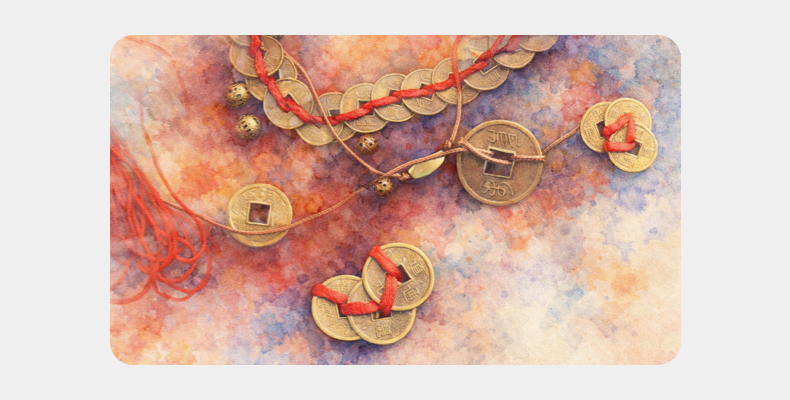
You need three identical coins. Assign values. Heads = 3 (Yang). Tails = 2 (Yin).
- Focus on your question. Phrase it openly. Ask “What do I need to know about…?” instead of “Will I get…?”
- Toss the three coins. Add their values together.
- Draw the line:
- 6 = Changing Yin (—x—) Old Yin, becomes Yang.broken line
- 7 = Stable Yang (——-) Young Yang, stays Yang.long line
- 8 = Stable Yin (— —) Young Yin, stays Yin. broken line
- 9 = Changing Yang (—o—) Old Yang, becomes Yin. long line
- Record the line from the bottom up. Toss and draw five more times.
- You now have your primary hexagram. Note any changing lines (6 or 9).
- Changing lines transform. A changing Yin becomes a solid Yang. A changing Yang becomes a broken Yin. This creates a second, future hexagram.
Find your hexagram number in the I Ching. Read its text, line statements, and commentary. The changing lines are especially significant. This process is a form of active meditation. It structures your introspection.
The I Ching as a Tool for Somatic Awareness
The I Ching’s real power is self-reflection. It asks you to pause. It invites you to consult your inner world. The hexagram’s imagery—a well, a mountain, a thunderstorm—works as a metaphorical mirror. Where in your life are you “crossing the water” (Hexagram 64)? Where do you need “gentle penetration” (Hexagram 57)? This practice builds somatic awareness. Your body often knows the answer before your mind does. The I Ching gives that knowing a language.
Practical Applications for Modern Well-Being
You can use the I Ching’s wisdom daily without coins.
For Decision-Making: Stuck between options? Contemplate Hexagram 39: Obstruction and Hexagram 40: Deliverance. They teach when to pause and when to advance.
For Personal Growth: See challenges as Hexagram 3: Difficulty at the Beginning. It promises that struggle leads to organic order.
For Relationship Harmony: Study Hexagram 31: Influence (Courtship). It teaches that true connection starts with inner openness.
For Creative Blocks: Meditate on Hexagram 30: The Clinging Fire. It speaks of clarity, inspiration, and sustained brilliance.
For Inner Peace: Hexagram 52: Keeping Still (Mountain) is a master guide. It teaches the power of meditative stillness. This aligns with our principles of grounding and presence.
Aligning Jing, Qi, and Shen
The I Ching deeply connects to Taoist Three Treasures framework.
- Jing (Essence): The stable, unchanging lines. They represent your core constitution and enduring truth.
- Qi (Energy): The changing lines. They represent the dynamic, flowing life force in motion.
- Shen (Spirit): The act of consultation itself. It is the conscious, reflective mind seeking harmony.
A balanced reading honors all three. It grounds in reality (Jing), acknowledges change (Qi), and seeks wisdom (Shen). This holistic view is central to our Foundational Jing Immersion.
Your Life as a Living Hexagram
Ultimately, the I Ching teaches that you are part of a flowing cosmos. Your life is a living, changing hexagram. Each day adds a new line. You are both the question and the answer. Consulting the I Ching is a ritual. It is a conversation with your highest self. It builds resilience, patience, and insight. You learn to see crisis as a changing line. You understand peace as a stable hexagram. Keep a journal of your consultations. Over time, you will see your own patterns of growth. You will navigate life with the wisdom of the sages and the confidence of your own heart.
Hungry for more life-changing wisdom? Read more articles on intuitive massage, touch and holistic healing arts:
- Shu-Ha-Ri: The Three Stages of Mastery in the Healing Arts
- The Gentle Heat: Discovering the Tradition and Restorative Power of Ganbanyoku
- Dynamic Thai Massage: The Art of Rhythmic, Moving Meditation